Questions:
What goes behind the process of naming a piece?
What materials were the hardest to work with when creating your pieces?
Do you like creating large scale pieces or small scale pieces more? Is one easier to focus on than the other?
Questions:
What goes behind the process of naming a piece?
What materials were the hardest to work with when creating your pieces?
Do you like creating large scale pieces or small scale pieces more? Is one easier to focus on than the other?
The Ready-Made-Dream Exhibition was created by the artist Sue Johnson and is currently housed in the University of Mary Washington’s Ridderhof Martin Gallery. The exhibit itself depicts American consumerism during the 1950’s and 60’s. During this time period, a modern looking home aesthetic was attractive, and many strove to achieve this “dream” home. When first walking into the exhibit, one factor dominates the eye. That factor is the enormous vinyl wall decals that reach from the floor to the ceiling. The vinyls are stuck onto the walls corner to corner, along with a few vinyls on the floor. The wall vinyls show household furnishings such as bookcases filled with books and decorative objects, a modern sitting room filled with furniture, a kitchen overflowing with pots, pans, and food items. In contrast, the floor vinyls are meant to look dimensional, almost if they could be touched. The floor vinyls depicted scenes of toys such as Lincoln log buildings set on a small rug. Although the walls appeared to be very crowded with the decorations and furnishings of a home, the actual rooms themselves were bare and empty, providing a large open space to walk around. This was very interesting because of how these two factors greatly contrasted. When the general idea of a “home” is thought of, many people picture it with decorations, furniture, and other personal items, that’s what makes it a home in the first place. Seeing the contrasting effect of the room the vinyls were hung in as completely bare and empty give the opposite idea of a home. The first room of the exhibit actually had some mixed aspects in it. The room had actual tangible and physical old rotary and corded phones. Going into the history behind the exhibit, it was meant to take place in America during the 1950’s and 60’s. This could be seen throughout all the art as this “home” would have belonged to the typical, white, nuclear family that lived in suburbia. The materials and objects in the “dream” houses were mass produced during American consumerism, so it is easy to imagine a neighborhood of houses looking exactly the same during the 1950’s and 60’s. The “dream” houses allowed many people to believe they were carrying out the American Dream, while buying products that, because they were mass produced, allowed them to be sold at cheap prices, meaning everyone was purchasing the same things.


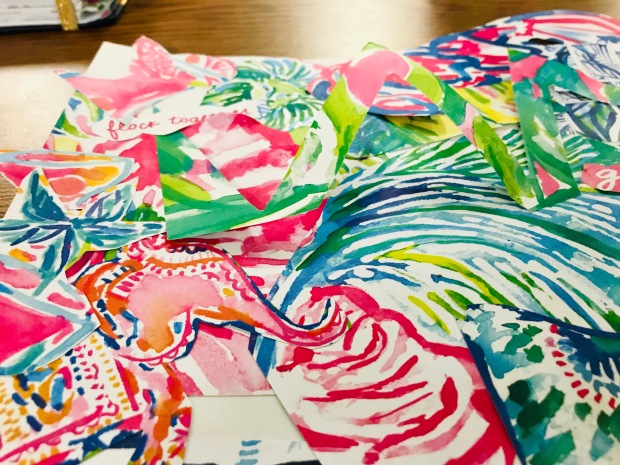

I chose this artist, Laura Row, because she primarily sells her art on the platform Etsy. I discovered Etsy a few years back when I was looking for some cute room decorations. Etsy is a website that connects artists (the sellers) to customers who want to buy products they create. Also I absolutely love her work! She went to college for a degree in graphic design and always knew painting and designing were her passions. She said that a fateful trip to Paris inspired her to open a shop on Etsy. I really appreciated her entrepreneurship! I really loved her art that depicted animals with bright and colorful paints. All of her works are very classy, cheerful and positive. The three questions I chose to ask her were, what about your trip to Paris inspired you to take up art seriously again, does this trip still inspire your work today, and what is the process behind creating one piece of work (how long does it take, what materials are used, thoughts and feelings while creating)? I decided to choose these questions because I want to know how amazing one trip had to be to inspire someone to take the big step and actually create a shop and a brand. Also I would love more insight on the thought process behind an individual pice of work and how much care and thought is put into it.


When I first stepped into the Ridderhof Martin Gallery, I was a bit underwhelmed. I walked in hoping to see something along the lines of the Renwick Gallery in Washington, D.C., but what I found instead was a small-scale gallery with exhibits that didn’t really pop out to me with first glance. When I took a closer look, I found a piece of art that was very intriguing. It was a tiny, singular chair that stood alone in what looked like an empty fold up wooden suitcase. I looked at the name of the work, The Wandering Gallery, and thought what a perfect name for this piece.
Just after reading the name, i started to study the piece. What first captured my attention was the perfect rectangle shape of the two boxes. I noticed how much this aspect contrasted to the more natural form of the adjacent wood plank, which began to curve inwards in a half crescent shape. The outside of boxes were made out of a very smooth wood, with perfect sharp corners. The wood was a medium brown chestnut color with visible grain. The inside of the boxes were a very light shade of tan which contrasted to the outside wood color. Also the inside of the boxes were very textured and appeared rough, which greatly differed from the smooth wood on the outside. The size of the piece appeared to be close to that of an average briefcase and there was a singular yellowish chair off to the left-hand side of the work.
Based of Abt’s other works at the gallery, I was able to start formulating some thoughts on the consistencies in his stylistic patterns. I observed that most of his pieces including the one I was looking at, had a very polished and finished wood grain look on the outside, in contrast to a very unfinished, sketch-like design on the interior. He kept consistent to the theme of his project, The Wandering Gallery, as all the works could be packed up in suitcase like boxes.
I researched some background information of Jeffery Abt in hopes of gaining a little more insight into his works. Abt is a professor in the James Pearson Duffy Department in Art and Art History of Wayne State University. He pursued curatorial and exhibitions work at the Wichita Art museum, the Special Collections Research Center of the University of Chicago, and the University’s Smart Musuem of Art. He’s an artist, an author, and co-editor for the Museum History Journal.
His recent work has been focused on the visual culture of museums, this is where the Wandering Gallery art series was born. According to Abt, it is the visual representation of the behind the scenes action of galleries and musuems. It symobizes the never-ending cycle of setting up and taking down new exhibits. The box like suitcase structure highlights the portablity of art and how it gets passed on from place to place.
One of the subjects I would like to continue to research is traveling. I chose this topic to begin with because it is something I love to do. I really do enjoy learning as much as I can about different places I go such as traditions, culture, fashions, food, and history. I like to see how much differently other people across the globe live from me here in the United States.
Thanks for reading,
Marissa
 Country Class and a Little Sass